HRZZ-UIP-2025-02
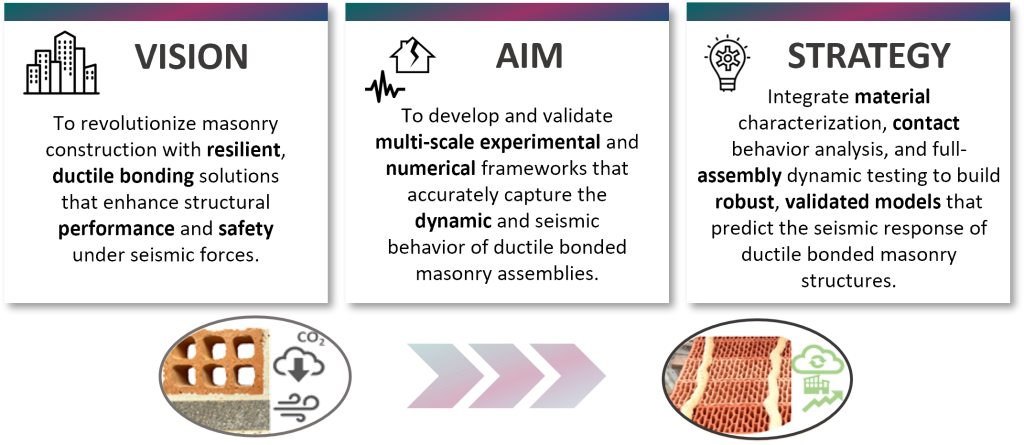
Masonry structures, widely used in civil engineering, remain highly vulnerable to seismic forces due to the brittle nature of traditional cement-sand mortar. The 2020 earthquakes in Croatia highlighted the urgent need for more resilient bonding solutions to enhance ductility, energy dissipation, and structural integrity of masonry. This project advances polyurethane adhesive foams as alternative binders, leveraging their high ductility and adhesion properties through an innovative modeling and experimental validation approach across scales. A key challenge in applying polyurethane foams in masonry is the lack of validated numerical models capturing their rate-dependent behavior, adhesion properties, and seismic response. This project develops a comprehensive numerical-experimental framework integrating material-scale analysis via rate-dependent and viscoelastic characterization at the University of Rijeka and Oxford, contact-scale modeling with an advanced cohesive zone model incorporating perforation effects, and assembly-scale validation through full-scale seismic tests at L.E.D.A. Laboratory in Enna. The project will establish a new research group at the University of Rijeka, fostering early-career researcher development with two postdoctoral researchers and a PhD student. Collaboration with Oxford in high-strain testing and Wienerberger for industry application ensures interdisciplinary and intersectoral impact. By combining numerical modeling and experimental validation, this research will define key mechanical parameters, validate advanced contact models, and assess the seismic performance of bonded masonry structures. The findings will support structural engineers, material manufacturers, and policymakers, contributing to seismic resilience, sustainable construction, and the future standardization of ductile bonded masonry technologies.